or, Why I Have Not Posted
On October 1, I found my father on the bathroom floor where he had fallen and was too weak to stand. The paramedics took him to the ER. He had internal bleeding that was not stopping. He was on warfarin therapy and had been taking an antibiotic that (unknown to me) potentiated its effects. His blood pressure was very low and he was dehydrated. I feared it was the end. Although he survived, this was the start of a series of adventures that took all my strength and then some.
Between my Dad's medical problems and my Mom's Alzheimer's, requiring 24/7 supervision, I did not touch a needle again until just before Christmas.
Things are more stable now, with the help of some wonderful folks from the Chicago Department on Aging's homemaking services and Vitas Hospice. I get some time to knit.
I started small -- some easy socks for myself, no brain strain. This soon escalated into adapting a simple sock pattern for part machine, part hand, and adjusting my ribber to meet the needs of the tight circle. I never did learn the KISS rule.
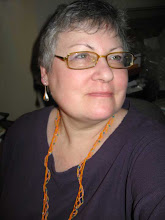
Oh, and I am not blonde any more. Photos soon.
C
Thursday, January 31, 2008


Sunday, October 21, 2007
Donna on Ethnic Knitting: Norwegian "Steek"

Here it is -- Donna Druchunas has graciously provided a Guest Post while I am preoccupied with caring for my aging parents full time. This is for any of us who have suffered from Fear of Cutting our hand knit fabric.
Donna writes:
Carol, thanks for having me as a guest poster as part of my blog book tour for Ethnic Knitting Discovery.
A few people on the tour have mentioned their anxiety about working steeks and cutting their knitting open, so I'd like to take a few minutes to talk about cutting knitting. For those who might not have heard the term "steek", I'll start with some basics. When you knit an entire sweater in the round, the body is one big tube. To create openings for the armholes, and sometimes for the front of the neck, you can cut the knitting. Yes, you cut it with scissors. Please don't faint.
Wool yarn works best for knitting that will be cut open, but any animal fiber or wool-blend yarn is also appropriate. If you've never cut your knitting before, don't try working with cotton or any other slippery yarn. Years ago, knitters simply took scissors to their knitting with no precautions to prevent unraveling. When you work with sticky yarn like Shetland or Icelandic wool, you'll find that nothing happens at all, and after a few wearings, the cut edges start to felt. But today we have many softer yarns, washable yarns, and fibers that don't felt. Some of these might tend to run or unravel when cut, so it's best to secure the knitting with machine or hand sewing before getting out the scissors.
The simplest types of armhole and neck openings are made with no special consideration during knitting. To try this for yourself, here are some instructions for making a swatch that you can cut. Every time I teach a workshop about this, the students sigh with relief after they cut this piece open and at least one person says, "I'm not afraid to cut my knitting any more."
Test Swatch for Cutting
Made with worsted-weight yarn in 1 or 2 colors using
CO 80 sts. Place marker to indicate start of round, and join being careful not to twist stitches.
On rnd 1, place a second marker of a different color after the first 40 stitches. The markers will indicate the placement of the armholes.
Work about 1 inch in K1, P1 ribbing or K1, P2 ribbing. If desired, add a second color. You can use any colorwork chart you like, or you can knit this in one color for practice.
Knit every round until the piece measures at least 6 inches, but if you feel like knitting more, knit until the piece looks to be about the right proportions to be the body on a doll sweater. About 8 or 10 inches should be about right, depending on your gauge.
BO, placing a removable marker at each armhole location.
Preparing to Cut
Ok, ready? See where your markers are? These are the spots where we'll cut the armholes.
Measure down about 3 inches from the bound off edge of the knitting, and put a pin to mark this as the bottom of the armhole opening. Now, with contrasting yarn and a darning needle, baste up the middle of the stitch marking the armhole so you can clearly see the straight column of stitches, then take out the pin.
Use a sewing machine with matching thread, and sew a row of stitches one-half stitch outside the basting, starting at the bound off edge, going down to the bottom of the armhole basting, then go across the stitch at the bottom of the armhole, and back up the other side. Repeat this again another half-stitch away from the first row of stitches. (If you don't have a sewing machine, you can use hand sewing and backstitch. Make small stitches and split the yarn strands as you sew, to catch all of the stitches securely.)
Cut
 Remove the basting. Then take a deep breath. With a pair of sharp scissors, carefully snip the stitches in the center of the rows of machine sewing.
Congratulations! You've just cut your first armhole open. You can sew and cut in the same manner to open the front of a cardigan.
What we've just done is cut a sweater armhole open in the traditional Norwegian style. We haven't really worked a "steek" on this swatch. A steek is made up of extra stitches that you cast on specifically for the purpose of cutting later on. Steeks are traditionally used in Fair-Isle sweaters and garments from other European countries. I explain steeks in detail in Ethnic Knitting Discovery, but I think this simple Norwegian cutting exercise is enough practice for today. I hope you'll take the time to try it and overcome the anxiety that many knitters have about cutting open their knitting.
Drawing by Deborah Robson, Nomad Press
Friday, August 31, 2007
Donna Druchunas Blog Tour - Ethnic Knitting: Discovery
Watch this space for Donna's October blog tour celebrating her latest book, Ethnic Knitting: Discovery: The Netherlands, Denmark, Norway, and The Andes . Donna will be here towards the end of this tour, on October 20th.
Here is a link to Donna's blog.
Here is a link to Donna's blog.
Friday, April 13, 2007
egoboo
Egoboo is a term I learned in the science fiction community. I got some this evening. It started with a great lecture about mittens from Rovaniemi presented by Susanna Hansson. I give my horn the first toot because I was able to deduce the technique, mostly from the finished samples. The final piece of the puzzle fell into place when I saw the work in progress. And that is all I shall say. Take Susanna's class.
My second toot is for the lovely outcome of the long-awaited face to face informal conference between Susanna and myself. It seems likely that I will have the honor of drawing the illustrations for some of her class materials. Pleasant common ground was tread, with the promise of more to come. A new kindred spirit in my life. Glee. Hope. Excitement. Anticipation. I wish we'd had about six more hours to chat, but we had to go do our homework.
My second toot is for the lovely outcome of the long-awaited face to face informal conference between Susanna and myself. It seems likely that I will have the honor of drawing the illustrations for some of her class materials. Pleasant common ground was tread, with the promise of more to come. A new kindred spirit in my life. Glee. Hope. Excitement. Anticipation. I wish we'd had about six more hours to chat, but we had to go do our homework
Sunday, January 28, 2007
One-End Wonder
Every ball of yarn has at least two ends, right?
I found the outside end of my center-pull ball. I dug inside for the inside end to start my swatch. No luck. Pulled out another bit. Still no luck. One more. Nope. The mess on the floor got more complicated. I thought about knitting the tangles into a piece of original fiber art, but kept looking. By the time I had that "inside" end the former ball was a tangled mess. While untangling, I contemplated the design I wanted to make with this skein.
Introducing: "Tangled Mess." It's adapted from Barbara Walker's "Wager Welt" or "All Fools' Welt" from the first Treasury, with a double loop stitch representing the tangle. I've hired a test knitter to proof the pattern, a first for me. When I have a completed sample, I'll post a photo.
No photo. The story proved more interesting than the object.
Tuesday, December 12, 2006
TOFUtsies Too


The second sock pattern for SWTC. This one was easier and more fun. I could get to like sock making after all.
Friday, December 01, 2006
Branching out to teach more stuff to more knitters
If you live in the Chicago area and are interested in expanding your knitting skills, I have developed a series of short classes around patterns in the new book One-Skein Wonders: 101 yarn shop favorites, edited by Judith Durant and Gwen Steege (Storey Publishing). See my October 27, 2006 post for more about my connection with this book.
Here is a link to a downloadable PDF of my proposed mini classes. http://cfmdesigns.net/One-Skein.pdf
The book is available at yarn stores, book stores, and online.
Knit Picks and Amazon show the same discount today.
If you or a small group of you and your friends want to set up a class, let me know.
Happy knitting,
Carol
Thursday, November 30, 2006
TOFUtsies
Here is the sock I designed for South West Trading Company's new sock yarn, TOFUtsies. I finished it last night. Now to neaten up the pattern and get it off to Jonelle at SWTC. I'm delighted to be among the designers who got a preview of this soft, pretty, comfortable yarn.


They are worked in typical Argyle fashion, with the cuff and leg done flat and the rest of the sock worked in the round like any other sock. You have a choice of knitting in the diagonal lines as you go or embroidering them on later in duplicate stitch. The pattern will be available exclusively from SWTC, with whom you may be familar as the makers of Soysilk® and many lovely natural fiber yarns.


They are worked in typical Argyle fashion, with the cuff and leg done flat and the rest of the sock worked in the round like any other sock. You have a choice of knitting in the diagonal lines as you go or embroidering them on later in duplicate stitch. The pattern will be available exclusively from SWTC, with whom you may be familar as the makers of Soysilk® and many lovely natural fiber yarns.
Saturday, November 25, 2006
Steeking at last

For about the last 14 hours I've been working on my steeked cardigan top-down multi-gauge multi-yarn sweater. I've got about four inches done from the neck out and down and have used about 6 yarns, two of them my own hand painted ones. It's got purple, magenta, fuchsia, violet, navy, red, dark royal blue, and (in a very small accent dose) all of the colors in the hand painted yarn I got at stitches originally intended for the Sandy, which include olive, burnt orange, black, plum.
I've been working up from sport weight at 5 sts/in in garter stitch (mandarin collar) on a size 5 needle to worsteds and bulkys and am up to needle size 8. Heading for no larger than an 11 and no fatter gauge than 3.5.
Color and texture techniques include stranded, slipped, and "Bohus" style purled accent blips.
Despite all the color that is there, the mixes and contrasts are pretty subdued, and the overall color is dark and warm and dramatic.
I might actually finish this one, since the most complicated shaping, colorwork, and gauge changes are in the yoke. Most of the knitting after that will be relatively routine.
Thursday, November 09, 2006
Oops
Some of you may know the little jingle often used to teach children how to knit
"In through the front door,
around the back,
down throught the window,
and off jumps jack."
Well, I use that for grownups, too. I had a small class this evening. About an hour into the session, one student got distracted and needed help figuring out what step she was on. I took a look, saw that all had been done except taking the old stitch off, and said, "you just need to Jack off."
As they say in the Reader's Digest, was my face red!
My student is eager for her next class.
"In through the front door,
around the back,
down throught the window,
and off jumps jack."
Well, I use that for grownups, too. I had a small class this evening. About an hour into the session, one student got distracted and needed help figuring out what step she was on. I took a look, saw that all had been done except taking the old stitch off, and said, "you just need to Jack off."
As they say in the Reader's Digest, was my face red!
My student is eager for her next class
Tuesday, October 31, 2006
Fine Art of Fiber
I have not finished "The Thing," but here are the pieces I entered in the exhibition:

Obi


The "Obi" was NFS, but the orange set, which I named "Strata," sold. It's an original incorporating some of my own polymer clay beads. Happy!

Obi


The "Obi" was NFS, but the orange set, which I named "Strata," sold. It's an original incorporating some of my own polymer clay beads. Happy!
Sunday, October 29, 2006
Arctic Lace Blog Book Tour
Donna Druchunas, author of Arctic Lace, has graciously agreed to be interviewed here about her research for this fascinating new book. Like all of my very favorite knitting books, this one is not just about knitting.
cfm: I'm sure that others will be asking you all about the animals, the fiber, and the stitches. What I'd really like to know more about is the The Yup’ik and Inupiat people from an anthropological standpoint. What got you interested in this particular part of the world?
DD: I read an article about the Oomingmak Musk Ox Producers’ Co-operative in Piecework magazine a few years ago (Berlo, Janet Cahterine, “Oomingmak: Knitting Vision into Reality,” Piecework, Jan/Feb 1996, page 50). After I read that, I became obsessed with finding out everything I could about the women in this organization, the founders, the knitting techniques used, and the musk ox. Of course, I also fell in love with qiviut (kiv’-ee-yoot) yarn.
cfm: Have you learned any of the native languages?
DD: I’ve only learned a few Eskimo words during my research for Arctic Lace. Until you asked this question, I’d never seriously considered learning one of the Native languages. But now I’m thinking, “Maybe I could learn Yup’ik!” I’ve always wanted to speak at least five languages. I know English, some Spanish and German, and will be studying a bit of Lithuanian for a trip next year. Maybe Yup’ik can be my fifth language. Thanks for putting that seed in my mind!
Here are a few interesting words:
Qiviut means “down”. The original Inupiat word meant either the feather down from a bird or the fur undercoat of a mammal. There is no standard English spelling. Some variations I’ve seen include qiviuk qiveuk, and qiviuq. The “qiviut” spelling is trademarked by the Oomingmak Co-op in Alaska. Today that spelling is generally used to refer to musk ox down, while other spellings are still used to refer to feather down or fur down, depending on the context.
Oomingmak means “the bearded one” and is the Inupiat name for the musk ox. A very fitting and descriptive name, since the outer guard hairs of the musk ox continue to grow throughout the animal’s life and can reach up to two feet in length.
Igloo or iglu means “house”. In Alaska, the traditional dwellings of both Yup’ik and Inupiat people were sod homes. In the south western river delta’s of Alaska, the Yup’ik people used driftwood to build the frames of their winter houses. In the north, the Inupiat people used whale ribs. In the summer, most of the people in both areas traveled to fish camps and lived in various types of tents and temporary dwellings.
Akutuq is Eskimo ice cream. It is made from rendered fat, meat (usually salmon or other fish), and berries. I was very disappointed that I didn’t get to try this or any other Eskimo dishes when I was in Alaska. Even in Unalakleet, where I stayed in a lodge, the meals served were hamburgers and other American “delicacies”. Not! I did get to have a lot of great seafood during my travels, however. I’d like to go back to Alaska in the summer and catch and dry some wild salmon, and pick wild berries to make jam. I’d also like to have a chance to try some authentic Eskimo dishes.
For those who want to learn more, there is an Inupiat dictionary online here: http://www.alaskool.org/LANGUAGE/dictionaries/inupiaq/default.htm
I have not found an online Yup’ik dictionary, but I was able to borrow the Yup’ik Eskimo Dictionary by Steven A. Jacobson on interlibrary loan.
cfm: Aboriginal peoples everywhere tend to name themselves “The People,” as if they were the only ones. The word Inuit means “people.” Yup’ik-speaking peoples call themselves “Yup’ik,” meaning “real person.” Is there a similar meaning to “Inupiat”?
DD: Yes, Inupiat does have the same meaning. I think it is very interesting that so many Native American groups called themselves “the people” or “the real people”. I assume that shows how the Native peoples across the Americas are related, and yet at the same time by calling themselves the real people, each group excluded the others as outsiders.
By the way, before I went to Alaska, I thought it was rude to use the word “Eskimo”, but while I was there I discovered that this term is used by the Native people to describe themselves. There are several distinct groups of Eskimos in Alaska including Yup’ik, Cup’ik, St. Lawrence Island Yup’ik, and Inupiat, so having an umbrella term to include all of these groups is helpful. It also helps to differentiate these peoples from the Indian groups that live in other parts of Alaska.
cfm: Aside from the knitting co-operative, were you able to look into other native arts and crafts? Which are still practiced by native artisans?
DD: Yes, I’ve been writing a series of articles for Piecework magazine called “Needleworkers of the North.” For the first article, I did a lot of research into the skin and fur sewing that is done by Eskimo men and women across Alaska. The second article was about Athabascan beadwork, and the third covered Tlingit and Haida button blankets. I’m currently working on a fourth article about quillwork, and I don’t think I’ve begun to scratch the surface.
cfm: Do you see any similarities between the Oomingmak Musk Ox Producers’ Co-operative and Emma Jacobsson’s Bohus knitters?
DD: The main similarity between the Oomingmak knitters and the Bohus knitters is that of economic imperative. This is something we talked about quite a bit at the Boise Lace Knitting Retreat I attended earlier this month. I gave a presentation about the Oomingmak co-op and Myrnah Stahman gave a presentation about Shetland lace knitters. Both groups developed lace knitting patterns that were primarily meant to be sold. The knitters on the Aran Islands in the early 20th century had similar goals, and even some Shaker knitters in the United States made rugs and other home decor items to sell to the general public. All of these groups were founded to generate income for people in rural communities.
They also all created unique styles of knitting that began as local products and ended up being instantly recognizable around the world. In addition, the products that are created use techniques and styles that are generally designed for speed of knitting and easy sizing. Aran sweaters, for example, were originally made in the circular fashion using fine, dark blue yarn. Later the heavy weight, natural colored yarn was used to make raglan and drop shoulder sweaters that were knitted flat in pieces and sewn together. These sweaters could be made more quickly and patterns for multiple sizes were easier to write for flat knitting. In the Oomingmak co-op, the left leaning decrease used is knit two together through the back loops. This is by far the fastest left leaning decrease to knit. Although it is not quite as tidy looking as slip slip knit or slip 1, knit 1, psso, the difference is negligible when knitted in lace-weight qiviut yarn (the stitches are quite small, and the bloom helps disguise the twisted stitches). I’m sure the Bohus knitters had their own tricks for making commercial products quickly.
cfm: You have said (and I paraphrase) that spirituality arises naturally out of human consciousness. Clearly you have given this a great deal of thought. What can you tell us about the spirituality of the people you encountered in Alaska? Do elements of the traditional beliefs remain, albeit in a Christianized context?
DD: Christian missionaries tried to squash the Native culture in Alaska during the early 20th century just as they did in the lower 48 during the 19th. They were somewhat successful in prohibiting Native dances and many ceremonies and rituals at first, but today the people are starting to practice some of their traditions again. Fortunately in many areas there are still Elders who remember many of the rituals and celebrations that were forbidden by the missionaries. As with other Native American groups, traditional Yup’ik and Inupiat spirituality focuses on the unity of man and nature.
I really cannot understand why Native Alaskan person would adopt the religion of the Europeans. These strangers came and gave absolutely no respect to the cultures that they found, beat children who spoke Eskimo in school, destroyed beautiful dance masks, and did everything they could to make the “savages” conform to their view of “civilization”. (I am not a cultural relativist, but I don’t think the Europeans and Americans of the 19th century, or the earlier explorers, exhibited behavior that qualifies as “civilized.”)
I read one essay by an Inupiat woman who explained that her grandparents had been very happy to adopt the white man’s religion, because before they heard of Christianity they were afraid of many of the spirits they thought surrounded them. Christianity alleviated this fear and they raised their children and grandchildren in the Christian faith. Today it seems like the majority of Eskimos are devout Christians.
Personally, I find it sad that these people gave up their beautiful traditions in exchange for a new set of superstitions. Wouldn’t it have been better for them to keep their own cultural treasures as traditions, even if they abandoned the belief in spirits that was frightening them?
cfm: What is the question you most wish I would ask?
DD: That’s a hard one. There are so many topics to talk about! In fact, the book as it stands today includes less than half of what I had originally written. I’m sure my editor had a heart attack when she read through the manuscript I originally turned in. But she was very diplomatic and helpful in pointing out the portions she thought were most appropriate for a knitting book and helping me revise each chapter to make it more friendly. I’m quite sure my original version would have been completely overwhelming to the average reader. The part I was saddest about deleting was a section describing some of the traditional Yup’ik and Inupiat ceremonies.
I learned so much during my research, I’m sure I could continue writing about these topics for the rest of my life, but other book ideas are also chomping at my heels.
cfm: Optional question: Most of what I think I know about contemporary Alaska comes from the TV show, “Northern Exposure.” If you are familiar with that show, could you point out some ways in which the reality differs from the fiction?
DD: Sorry, but I’ve never seen Northern Exposure. I do have one interesting entertainment note, however. The 2002 movie, Insomnia, starring Robin Williams supposedly took place in Nightmute, Alaska. Several knitters from the Oomingmak Co-op live in Nightmute. The village’s population is over 90% Native, and yet in the movie, the town is predominantly white. I guess they just thought the name “Nightmute” sounded good, but they didn’t care to use the real village in the film. So much for authenticity!
cfm: Thank you so much for your insights and time.
DD: Thank you for asking such interesting and thought provoking questions!
Donna
Subscribe to:
Posts (Atom)