Sunday, March 22, 2009
Mia Mysteriously Reappears
Tuesday, March 03, 2009
Mia is missing
Saturday, February 07, 2009
Mia
Sunday, February 01, 2009
Tuesday, January 27, 2009
King of the Road
Friday, January 23, 2009
Cats


Tuesday, November 11, 2008
knitting again at last


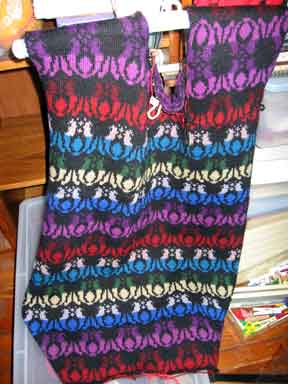
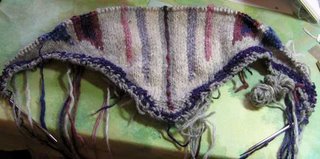
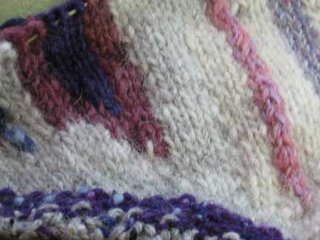
Finally cleared away enough space to resume work on The Thing. Borrowed yarn organizer technique from Susanna Hansson's Mittens from Rovaniemi lecture.
Monday, February 25, 2008
What Not to Knit

Today's stop on Donna Druchunas' Kitty Knits Blog Book Tour.
When Donna asked me to blog about cats and knitting, the first thing that came to mind was the saga of Pussywillow and the Sweater.
Pussywillow was a tiny Oriental Shorthair, named after her toes, which looked and felt exactly like pussywillow catkins. Willow was an affectionate cat, usually good-tempered and only a little shy with strangers. Typical Siamese/Oriental personality. She had a brief show career, earning a name longer than she was: Champion Tombar’s Pussywillow of Mrp.

She often got cold in the show halls, and I decided to knit her a sweater. This was in the Olden Days, when I had no money. Most of my yarn was from Harriet's, the local “dime store,” and from its sale bin at that. I had some cheap acrylic sport weight in a harvest gold color with multicolor tweedy flecks in it. Nice contrast with the lavender/cream tortie colors of her fur. So I measured her, and designed a little sweater in a moss stitch pattern, and knit it up.
She endured this thing for exactly minus two seconds. This tiny mellow cat bit me in her frenzy to get the thing off before I'd finished putting it on her. I unraveled it.
I do not know what became of the yarn, but I do know that it is no longer a part of my collection. If it were, I would take a picture of it just to show you how hideous it was.
Thursday, January 31, 2008
Pay no attention to the blonde behind the curtain
On October 1, I found my father on the bathroom floor where he had fallen and was too weak to stand. The paramedics took him to the ER. He had internal bleeding that was not stopping. He was on warfarin therapy and had been taking an antibiotic that (unknown to me) potentiated its effects. His blood pressure was very low and he was dehydrated. I feared it was the end. Although he survived, this was the start of a series of adventures that took all my strength and then some.
Between my Dad's medical problems and my Mom's Alzheimer's, requiring 24/7 supervision, I did not touch a needle again until just before Christmas.
Things are more stable now, with the help of some wonderful folks from the Chicago Department on Aging's homemaking services and Vitas Hospice. I get some time to knit.
I started small -- some easy socks for myself, no brain strain. This soon escalated into adapting a simple sock pattern for part machine, part hand, and adjusting my ribber to meet the needs of the tight circle. I never did learn the KISS rule.
Oh, and I am not blonde any more. Photos soon.
C
Sunday, October 21, 2007
Donna on Ethnic Knitting: Norwegian "Steek"

Here it is -- Donna Druchunas has graciously provided a Guest Post while I am preoccupied with caring for my aging parents full time. This is for any of us who have suffered from Fear of Cutting our hand knit fabric.
Donna writes:
Carol, thanks for having me as a guest poster as part of my blog book tour for Ethnic Knitting Discovery.
A few people on the tour have mentioned their anxiety about working steeks and cutting their knitting open, so I'd like to take a few minutes to talk about cutting knitting. For those who might not have heard the term "steek", I'll start with some basics. When you knit an entire sweater in the round, the body is one big tube. To create openings for the armholes, and sometimes for the front of the neck, you can cut the knitting. Yes, you cut it with scissors. Please don't faint.
Wool yarn works best for knitting that will be cut open, but any animal fiber or wool-blend yarn is also appropriate. If you've never cut your knitting before, don't try working with cotton or any other slippery yarn. Years ago, knitters simply took scissors to their knitting with no precautions to prevent unraveling. When you work with sticky yarn like Shetland or Icelandic wool, you'll find that nothing happens at all, and after a few wearings, the cut edges start to felt. But today we have many softer yarns, washable yarns, and fibers that don't felt. Some of these might tend to run or unravel when cut, so it's best to secure the knitting with machine or hand sewing before getting out the scissors.
The simplest types of armhole and neck openings are made with no special consideration during knitting. To try this for yourself, here are some instructions for making a swatch that you can cut. Every time I teach a workshop about this, the students sigh with relief after they cut this piece open and at least one person says, "I'm not afraid to cut my knitting any more."
Test Swatch for Cutting
Made with worsted-weight yarn in 1 or 2 colors using
CO 80 sts. Place marker to indicate start of round, and join being careful not to twist stitches.
On rnd 1, place a second marker of a different color after the first 40 stitches. The markers will indicate the placement of the armholes.
Work about 1 inch in K1, P1 ribbing or K1, P2 ribbing. If desired, add a second color. You can use any colorwork chart you like, or you can knit this in one color for practice.
Knit every round until the piece measures at least 6 inches, but if you feel like knitting more, knit until the piece looks to be about the right proportions to be the body on a doll sweater. About 8 or 10 inches should be about right, depending on your gauge.
BO, placing a removable marker at each armhole location.
Preparing to Cut
Ok, ready? See where your markers are? These are the spots where we'll cut the armholes.
Measure down about 3 inches from the bound off edge of the knitting, and put a pin to mark this as the bottom of the armhole opening. Now, with contrasting yarn and a darning needle, baste up the middle of the stitch marking the armhole so you can clearly see the straight column of stitches, then take out the pin.
Use a sewing machine with matching thread, and sew a row of stitches one-half stitch outside the basting, starting at the bound off edge, going down to the bottom of the armhole basting, then go across the stitch at the bottom of the armhole, and back up the other side. Repeat this again another half-stitch away from the first row of stitches. (If you don't have a sewing machine, you can use hand sewing and backstitch. Make small stitches and split the yarn strands as you sew, to catch all of the stitches securely.)
Cut
Remove the basting. Then take a deep breath. With a pair of sharp scissors, carefully snip the stitches in the center of the rows of machine sewing.
Congratulations! You've just cut your first armhole open. You can sew and cut in the same manner to open the front of a cardigan.
What we've just done is cut a sweater armhole open in the traditional Norwegian style. We haven't really worked a "steek" on this swatch. A steek is made up of extra stitches that you cast on specifically for the purpose of cutting later on. Steeks are traditionally used in Fair-Isle sweaters and garments from other European countries. I explain steeks in detail in Ethnic Knitting Discovery, but I think this simple Norwegian cutting exercise is enough practice for today. I hope you'll take the time to try it and overcome the anxiety that many knitters have about cutting open their knitting.
Drawing by Deborah Robson, Nomad Press
Friday, August 31, 2007
Donna Druchunas Blog Tour - Ethnic Knitting: Discovery
Here is a link to Donna's blog.
Friday, April 13, 2007
egoboo
My second toot is for the lovely outcome of the long-awaited face to face informal conference between Susanna and myself. It seems likely that I will have the honor of drawing the illustrations for some of her class materials. Pleasant common ground was tread, with the promise of more to come. A new kindred spirit in my life. Glee. Hope. Excitement. Anticipation. I wish we'd had about six more hours to chat, but we had to go do our homework


Van Morrison, Emmett, Tommie Girl, Siamese, Evangeline, Ebony